

Liquid gold
Tony wasn't walking far. In fact, he was only taking out the bins.
But in hospital, after his collapse, he was told he may never walk again.
Tony had been paralysed by Guillain-Barré syndrome (GBS), a rare condition where the immune system attacks the body. The syndrome damages peripheral nerves, leading to numbness and muscle weakness. It is life-threatening, especially if the muscles around the lungs are affected.
Tony's collapse came just three weeks after he had completed his last chemotherapy treatment for bowel and liver cancer.
"It was just like somebody had flipped the switch and he just had lost all use of his body," says Lauren, Tony's daughter. "We all thought it might be brain cancer pushing on a particular part of his brain and causing him to not be able to use his legs. It was all very scary."
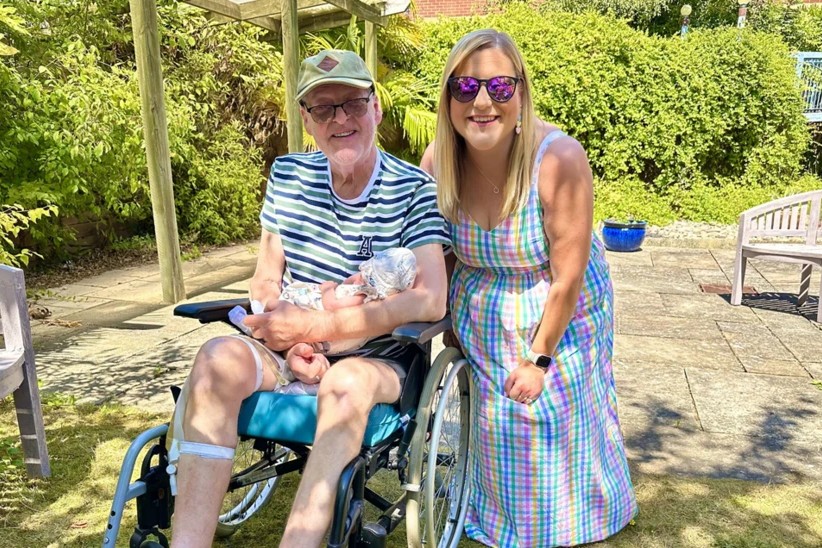 Amongst Lauren's fears was the thought that her dad may never meet her daughter: she was pregnant with her first child.
Tony was diagnosed with GBS and transferred to a neurological ward, where his condition continued to deteriorate until he received 2 treatments, both derived from donated plasma.
Plasma, which makes up around 55% of blood volume, contains antibodies called immunoglobulins. Tony received 5 infusions of these immunoglobulins intravenously, before a further 5 therapeutic plasma exchanges.
In his words: "liquid gold."
Tony's condition greatly improved, and after months of intensive physiotherapy, he defied all expectations and walked out of hospital.
"Due to my age and the spread of the GBS, my prognosis for recovery was not great," he says. "I was told I may never walk again. I categorically disagreed and told the doctors that I would walk again and that when I did, I would do it in a tutu – and so I did!
"It was truly something I will never forget."
 Lauren, meanwhile, had given birth to baby Isabelle. It was a month before Tony could meet her for the first time and hold her in his arms.
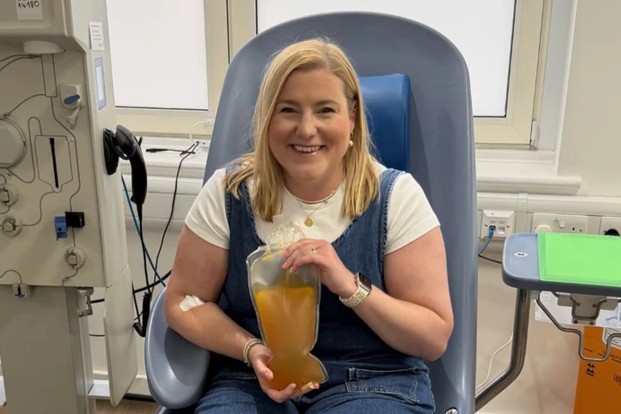
In an intriguing twist, Lauren, a committed blood donor, had actually already switched to giving plasma, not knowing that 'liquid gold' like hers would go on to help save her father's life.
Inspired to start giving blood at 17 after losing one of her closest friends in a car accident, Lauren made the switch to plasma donation after learning that a dedicated plasma donor centre had opened in Birmingham.
"Never did I think that plasma would save my dad's life," she says. "Plasma donation is a great thing to try, and I am so keen to get more people aware of it and to sign up. If you are not near a plasma donor centre, you can still sign up and donate blood, because plasma can be recovered from every blood donation too."
Tony continues to carry out daily exercises at home. Despite still experiencing neuropathy and fatigue, he is otherwise well, and was able to enjoy his first family holiday abroad in 3 years in April.
"Without donors, many people's recoveries would not be possible," he says. "People often think blood donations are only needed in emergencies, but blood and plasma also help people facing serious illnesses and long recoveries like mine.
"I encourage everyone who is eligible to consider donating, and I would also like to thank everyone who already does. Their plasma makes essential life-saving medicines."